
One of the most potent and most resisted tools in the CLG tool kit is the drama triangle. Like many of our tools, the drama triangle is not original to us. It was developed by Stephen Karpman and expanded by David Emerald in The Power of TED. Emerald added the roles of creator, coach, challenger (above the line) to victim, villain, hero (below the line).
Learning the drama triangle and how to use it is part of every training CLG offers. Everyone attending an event is asked to pick a real life issue where they’re below the line. After exploring how their individual below-the-lineness is showing up they are invited to act out the drama of their issue in the triangle. The assumption we make is that if you’re below the line you’re in the drama triangle. You’re in some flavor of victimhood, victim, villain and/or hero around your issue. Everyone is given two minutes to stand on the triangle and talk about their issue in dramatic exaggerated form (think Real Housewives or Jerry Springer) while they move their feet from base to base and role to role (victim, villain, hero).
Many people resist doing this activity especially if the training is happening at work and they’re surrounded by their colleagues. With some cajoling by the facilitator and modeling by the team leader, people (often still grudgingly) play. But once the training is over and the team is left on their own to practice the tools, playing in the drama triangle around real life work issues in real time is a tool that rarely gets practiced.
Why?
Most would say, they don’t see the value of it AND it’s silly and embarrassing to ham it up and exaggerate. Also, it’s real, raw and vulnerable. Finally, it can be threatening to others on the team for a team member to talk about how they really view the issue when they’re below the line.
All of this makes sense to me. In fact, if you were to really know me, I, too, viewed playing in the drama triangle as silly, even stupid and meaningless when I was first introduced to it by Katie Hendricks 20 years ago (Hendricks Institute).
So, let me tell you about my journey and what I’ve learned is the value of doing the drama triangle. I’ll give you a gentle on ramp, step by step, for the skeptics and resistors in the crowd. I’ll tell you what to do and why to do it.
Here are the benefits of using the drama triangle in your life and at work:
1. Gain awareness and insight into your pattern of reactivity, defensiveness and victimhood.
Self awareness is one of the first keys to conscious leadership. Being able to see your patterns is essential to being able to shift them. That’s why the first question we ask leaders doing an exploration is “Where are you?” The first response is either above or below the line. But the deeper question is where are you in victimhood (the consciousness that sees life as happening TO ME)? Are you hanging out in the victim, villain and/or hero role? This question is an eye opener for most leaders. Answering it honestly gives you tremendous insight into how your racket is showing up. Just look at the three flavors of victimhood and what each says:
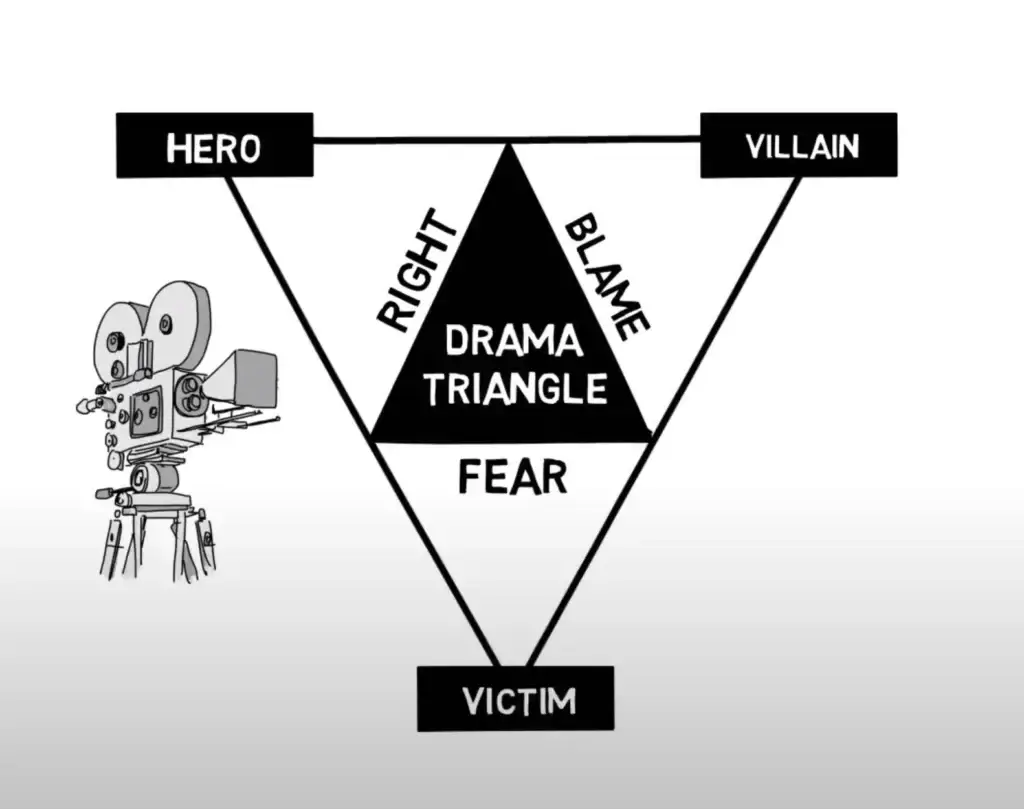
Seeing and owning how victimhood is showing up for you is a game changer. It’s one of the first steps to taking responsibility for how your life is unfolding.
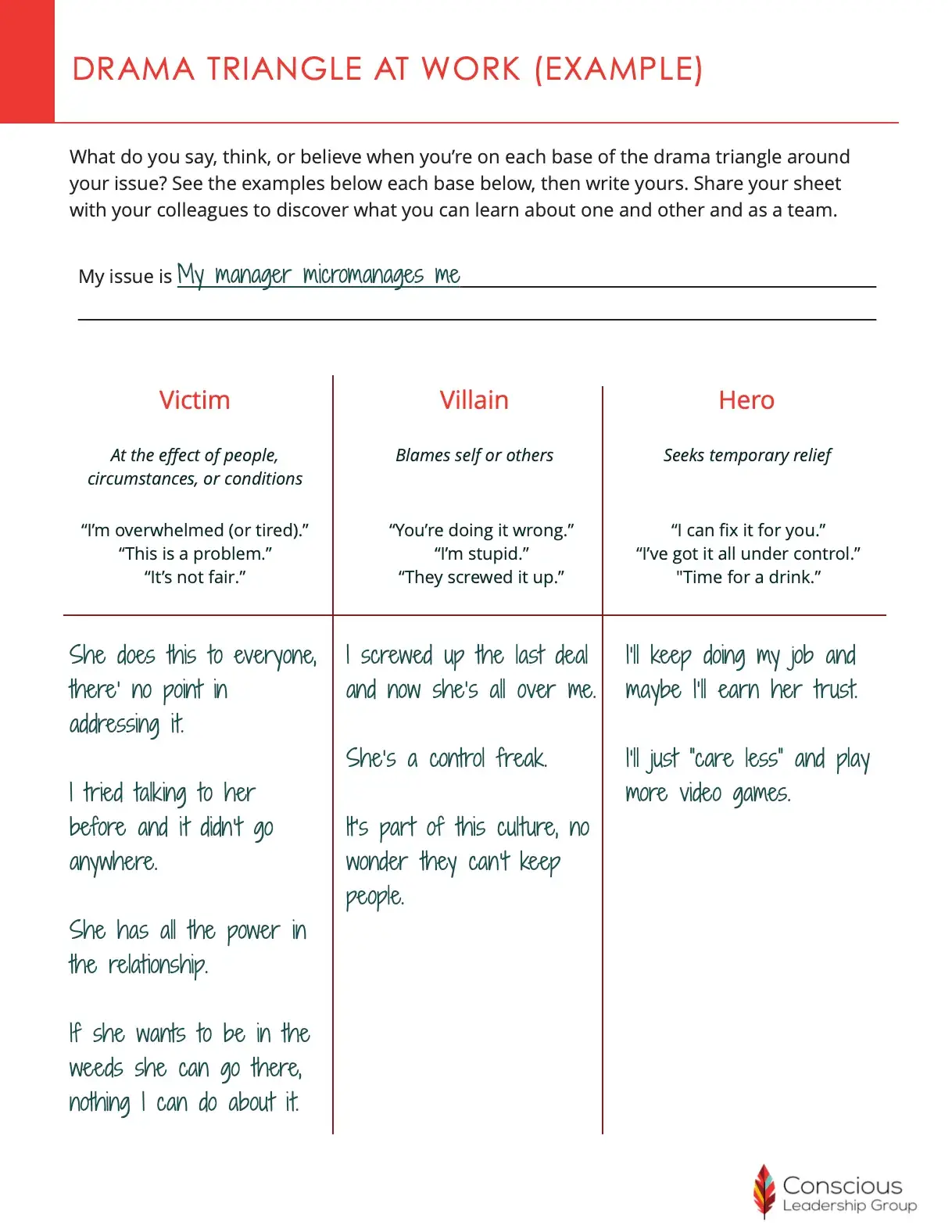
You can gain some of this necessary insight without playing full out on the drama triangle. You can do it on your own, especially if you’re willing to do a little journaling. Just use this as a prompt for writing about your issue and look for how each flavor is showing up.
Here’s an example for a typical business issue…
2. See how you’re enrolling others in your drama triangle.
An aha moment occurs on the conscious leadership path when you realize that you actually require other people to be playing certain roles in the triangle. If you’re standing on the victim base you require someone or some group to occupy the villain and hero bases. You can’t keep your racket going unless you’re seeing someone playing these roles. The aha of radical responsibility is to own that you actually need to see your boss as an unappreciative villain (denying all data to the contrary) for you to keep living as a disempowered victim who’s at the effect of your boss. You need to enroll your colleagues as heros who give you temporary relief from your suffering by gossipping with you and agreeing that your boss is unappreciative.
This potentially transformational insight comes as you use the drama triangle and see how you are creating your reality. So the question to ask is, “What roles are other people playing in your drama and how are you requiring them to play those roles?”
Once you see this you can share with a colleague how you need to see the people showing up in your drama triangle to keep the issue going. What this does is it moves your attention away from others and toward yourself. Only when your attention is on yourself can you shift your drama pattern.
3. Begin the journey of taking radical responsibility by physically standing and stepping on to the drama triangle.
The first two benefits of the drama triangle can be gleaned by you doing some thinking, reflecting, and journaling. They are powerful and accessible to you in private. The next benefits require you to get out of your head and into your body and eventually out of solitude and into community. These two movements, from head to body and from solitude to community are risky; that’s why people resist and avoid them. But the benefits of the drama triangle go up significantly when you take the risk.
The first risk is to get embodied. Drama and reactivity live in the body, not just the head. They live in feelings and sensations and not just thoughts. Drama is shifted when all three centers—head, heart and body —shift:
For this reason, we provide every attendee at our events with a set of victim, villain and hero cards. We invite them to put them on the floor, stand up and step onto the drama triangle. The act of standing and stepping into the triangle is the beginning of ownership. You are moving your body into the drama triangle and in so doing saying, “I’m in drama around this issue.” You are locating yourself and by standing and stepping you are matching with your body what you’re exploring. Powerful.

As you tell the story of your issue you are moving from one base to another, sometimes with one foot on one base and another foot on another. You are becoming aware of how you are playing this drama game around the issue. This is potent self-awareness.
You can actually do this alone as well. Just set a timer for two minutes and go for it.
But, the learnings and potency go up dramatically when someone else is witnessing you do your drama. Being witnessed by someone who isn’t giving advice or problem solving creates space for you to more deeply see yourself and what you’re up to. The role of the witness is just to be there. They can only say one of two things: “Then what happens?” or “Can you make it bigger?”
“Then what happens?” comes when you’re stuck or running out of juice. It invites you to see that most of your dramas have patterns where one thing happens and then another and another and another. Seeing the pattern is important.
4. “Make it bigger;” the power of exaggeration and play.
The real shift with the drama triangle occurs when you are willing to make it bigger, exaggerate the drama. What happens when exaggeration occurs is that, for most people, at some point in the dramatization, you see how silly you are. Yes, that’s right. From one perspective you and your drama are silly. When you’re trapped in your drama it seems very serious, but as you play with your drama through embodiment and exaggeration a little crack in the seriousness begins to occur and you start to be able to see what’s happening and what you’re creating with more spaciousness and less tightness. This spaciousness and lightness is what’s needed to learn and shift your pattern.
But it’s this last step … playful exaggeration, that most people resist. They don’t want to look silly, they don’t like hamming it up. I get it. Over the years, I have had the incredible privilege of watching people on the CLG team, Diana first and foremost, who are naturally more playful and often more willing to risk being uncomfortable than I am, show me the power of the drama triangle. They’ve invited me to come play and as I have I have experienced the power of this simple tool. I invite you and your team to come and play with us.
The final step for a team is to take a business issue that is real, current, and affecting all of you. Put the drama cards on the floor and take two minutes each to express your personal version of drama around this issue. When it’s done collectively, with curiosity and responsibility lasting shifts can occur.

More
- Teaching your drama class – Practicing more with the drama triangle, and diving deeper into this commitment of responsibility