
The way you set goals matters.
We’ve seen that goals set from below the line (a state of fear) can lead to a sense of obligation, burnout, frustration, and drama. But we also know that achieving goals—as an individual, a team, and an organization—can be profoundly satisfying, especially when they align with your deeper values and sense of purpose.
How do you set goals that are motivating and empowering, rather than a cause of drama or disengagement? Conscious leaders pay attention to HOW they’re setting goals, and from WHERE they’re setting them.
What goals look like from above and below the line
Above:
-
I want to
-
I choose
-
Goals are in service of my ability to focus
-
Goals are fun and help me gamify my creativity
-
I know exactly who will do what by when
-
Goals help me and my team be cohesive about how we’re going to organize ourselves creatively
-
Goals invite me to go into some stretch, knowing that I’m not attached to having to succeed at them in order to feel safe, accepted, and in control
-
Goals come from taking responsibility for what I really most want to create in the world
Below
-
I have to
-
I don’t have a choice
-
Goals are an impediment to my freedom
-
Goals are a burden that somebody else says I have to do.
-
I see goals as creating a structure that keeps me from my creativity
-
Ambiguous, not everybody can be clear about them, doesn’t create cohesion
-
I create only the ones I know I can do to stay safe, or lofty goals I don’t believe I can get to
-
There’s a flatness, not the thing that most turns me on. Comes with a lot of duty and obligation
3 steps to set goals from presence
-
Acknowledge that setting goals is a choice. You can’t have a real Yes if it’s not ok to say No. Can you let it be ok that you don’t HAVE to set goals? If you feel attached to the idea that you should set goals, can you see that the opposite of your story might be just as true?
-
Give voice to the rebel inside. Most of us have parts that don’t want to set goals. Often, those parts get pushed aside and denied—and then cause drama later. Conscious leaders are willing to let those parts all the way out and play with them.
You might invite everyone to have a temper tantrum and express the parts of themselves that don’t want to set goals. Ask: Is there intelligence our rebels bring that we’d be wise to listen to?
-
Get clear on WHY you’re choosing to set goals. After allowing a No and letting the rebels out, if you do choose to set goals, get clear on your goal-setting purpose.
Some reasons you might choose to set goals:
-
It can be fun to compete with yourself or others
-
Goals help you focus
-
Goals give you a shared game plan
-
Goals push you beyond the status quo.
-
Clear goals can keep you from overcommitting.
The 5 Levels of Motivation
As you explore your purpose for your goals, consider the 5 Levels of Motivation. You can set or achieve goals at any of these levels, or a combination. It’s possible to set goals above the line from any level except the bottom, fear.
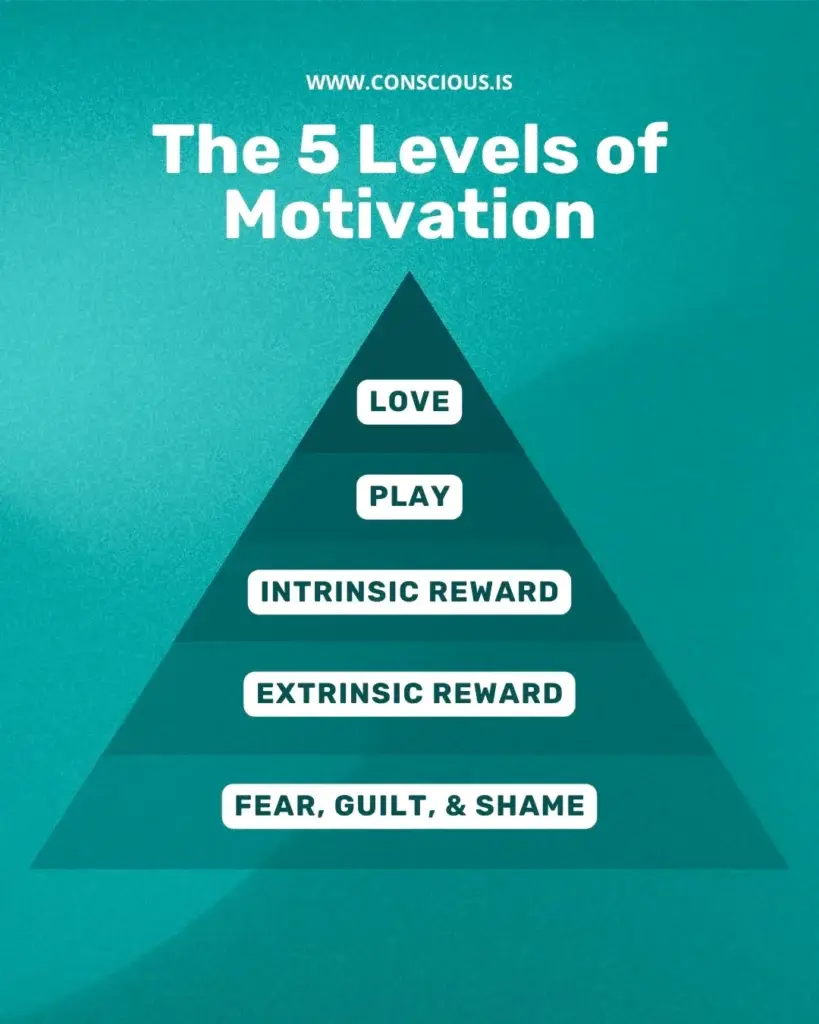
Here’s what setting goals might look like from each of the levels:
-
Fear: “If I don’t make these numbers I’ll lose my funding.”
-
Extrinsic reward: “I’ll get a bonus if I make these goals.”
-
Intrinsic reward: “If I reach this goal, I’ll have met my purpose to impact 1,000 people.”
-
Play: “It will be so fun to get to this goal.” (Note: When play is the motivation, you know it’s a game; you don’t attach meaning about your own value to whether you do or don’t achieve the goal.)
-
Love: “This goal is what I sense love wants to do to fulfill itself.”
Goal Setting Warnings by Enneagram Type
We find that each Enneagram type has its own challenges and tendencies to go below the line when setting goals. When you know your type (and the types of those around you), you can watch out for these common drama-inducing mindsets towards your goals. (These hints come from coaches on our team, each about their own types.)
-
Type 1 – The Reformer: Watch out for setting goals that are “appropriate” but not what you really want. And then be careful to hold the goals lightly so you can adjust as conditions change — rigidity can kill creative flow.
-
Type 2 – The Giver: Watch out for setting goals that may sacrifice your own deepest needs. Pay attention to any goals related to requiring or needing approval and love. Watch out for setting goals with the thought, “Something/someone needs to be fixed.” Instead, ask, “What do I need right now?” Set goals that include head and gut, as your heart is so big.
-
Type 3 – The Achiever: Watch out for when the mind is imagining who will be impressed by the achievement. Use that as an awareness flag to check if the goal is authentically yours versus an attempt to impress. Be wary of overcommitting and burnout. You likely value your generative capacity more than your need for rest and renewal. Consider the motivation behind your goals. What or who do you believe will be satisfied if you achieve this goal? If that need or desire was already satisfied — would this goal still be important? Discover your motivation beyond external validation to bring your authentic self online.
-
Type 4 – The Individualist: Watch out for making goals that focus on fantasy and feeling: “I want to feel happy and free,” or “I want to throw everything out and start over.” It can be easy to focus on chasing what you don’t have vs. appreciating what is here that needs nurturing, consistency and growth. Fours can also set goals from the heart and rely on inspiration, then fall into suffering when the inspiration is gone. Check for the instinct of self-sabotage as well. Instead, set goals slowly. Decide on a goal and leave it for a few days. Practice Whole Body Yes, particularly from the gut. Set balanced goals that amplify and improve what’s here and now, not just what’s missing that you long for.
-
Type 5 – The Observer: Watch out for setting goals primarily from your head or always needing the head to approve of your goals; you’ll keep yourself stagnant at best. Tune into your whole being—including head, heart, and instinct—when setting goals. Use your gift of taking multiple perspectives to set goals that if attained will delight you beyond your wildest imaginings.
-
Type 6 – The Loyal Skeptic: Watch out for coming up with all sorts of reasons your goals will not be attainable. That’s useful for avoiding trouble down the road. But for getting started, be bold. Focus instead on your vision and all the things that can go right, all the resources you already have to achieve your goals. You got this.
-
Type 7 – The Enthusiast: Watch out for setting goals that aren’t fully grounded in the business and might overlook practicalities and/or might overload the team. Then watch out for losing interest in those goals and racing to the finish line. Watch out for enthusiastically taking on too much and then under delivering. Make sure goals are SMART (specific, measurable, achievable, relevant and time-bound) and aligned.
-
Type 8 – The Challenger: Watch out for believing you have more capacity than you do, taking on too much, then falling short from a place of denying your vulnerability/limitations. Watch out for creating unachievable goals. Make sure your goals don’t require others to lose their wellbeing to help you fulfill. It’s not just you!
-
Type 9 – The Mediator: Watch out for merging with other people’s ideas about what they think your goals should be. Take time alone to get clear. Also watch out for procrastinating on making your goals, because it’s too uncomfortable to make a decision.
A few more tips for setting motivating goals
Plenty of experts have great content and tips about how to set goals. We’ll leave you with just a few ideas:
Picture it done
Write the goal as if it’s already happened in a way that’s exciting to imagine. For example, “CLG brought 360 organization leaders through 12 sold-out Taste of Conscious Leadership events this year.”
Listen to the wisdom of your emotions
Listen to your three centers of intelligence (head, heart, and gut). See if you notice joy and/or sexual energy. Do you feel excited about the goal? Are you turned on? Does it feel good? Is it sexy? Your goals should make you even more excited about what you’re doing. If not, return to the tips and check if you’re setting goals from obligation.
Assess the stretch
We recommend that you find goals that are gentle stretches into the unknown. Do you think you have a shot at making it? Are you setting goals you know are safe so you don’t risk failing? Or are you setting impossible goals that might burn you out? We see a lot of teams not being honest about the fact that they only have so much time and energy to complete things. People can get very optimistic about what they can accomplish and overcommit. Aim for goals that stretch you into evolution with realistic time for rest.
Check that your goals set you up for integrity
Integrity (energetic wholeness) requires clear agreements: Who, will do what, by when? Does your goal clearly identify all three? WoGoals without timelines are a setup for drama.
Go forth and set presence-based goals
An above-the-line mindset around goals fundamentally changes how conscious leaders engage with their work. When goals stem from a place of choice and desire, rather than compulsion, they resonate more deeply with our personal and collective missions. Set goals not because you have to, but because you genuinely want to—and watch how this shift transforms not just your achievements, but your entire approach to life and work.
All the best,


More
- What’s Your Iceberg? – If you want to see this process in a fun form, check out this animation: