
The Stoic philosopher Epictetus nailed when he wrote the following around 100 AD:
“Happiness and freedom begin with a clear understanding of one principle: Some things are within your control. And some things are not. It is only after you have faced up to this fundamental rule and learned to distinguish between what you can and can’t control that inner tranquility and outer effectiveness become possible.”
We see this principle in action every day with our clients. We walk them through facing and distinguishing between what they can and cannot control. Then we show them how to turn their awareness into action, which is key to the inner tranquility and outer effectiveness that Epictutus is pointing towards.
We’re excited to share this process we use with our clients to cultivate awareness and inspire action with you. Take the short quiz to assess how much you already know about what you can and can’t control as a leader. You may be surprised to discover which is which. Use the PDF handout to guide yourself—and your team—through cultivating in the moment awareness and then taking action.
When we go through this process with clients, it’s game changing in terms of results, stress levels, and joy. We wish the same for you!
How did you do? Spot on? Surprised?
Keep reading to find out what is actually under your control and what isn’t. And what to do in the moment when you realize that you’re focusing (aka wasting) attention on something you can’t control.
The Process
Use this process when you’re feeling stressed, unhappy, pressured, or upset.
1. Identify the Issue
Face that something isn’t working for you and name it.
2. Sort the files
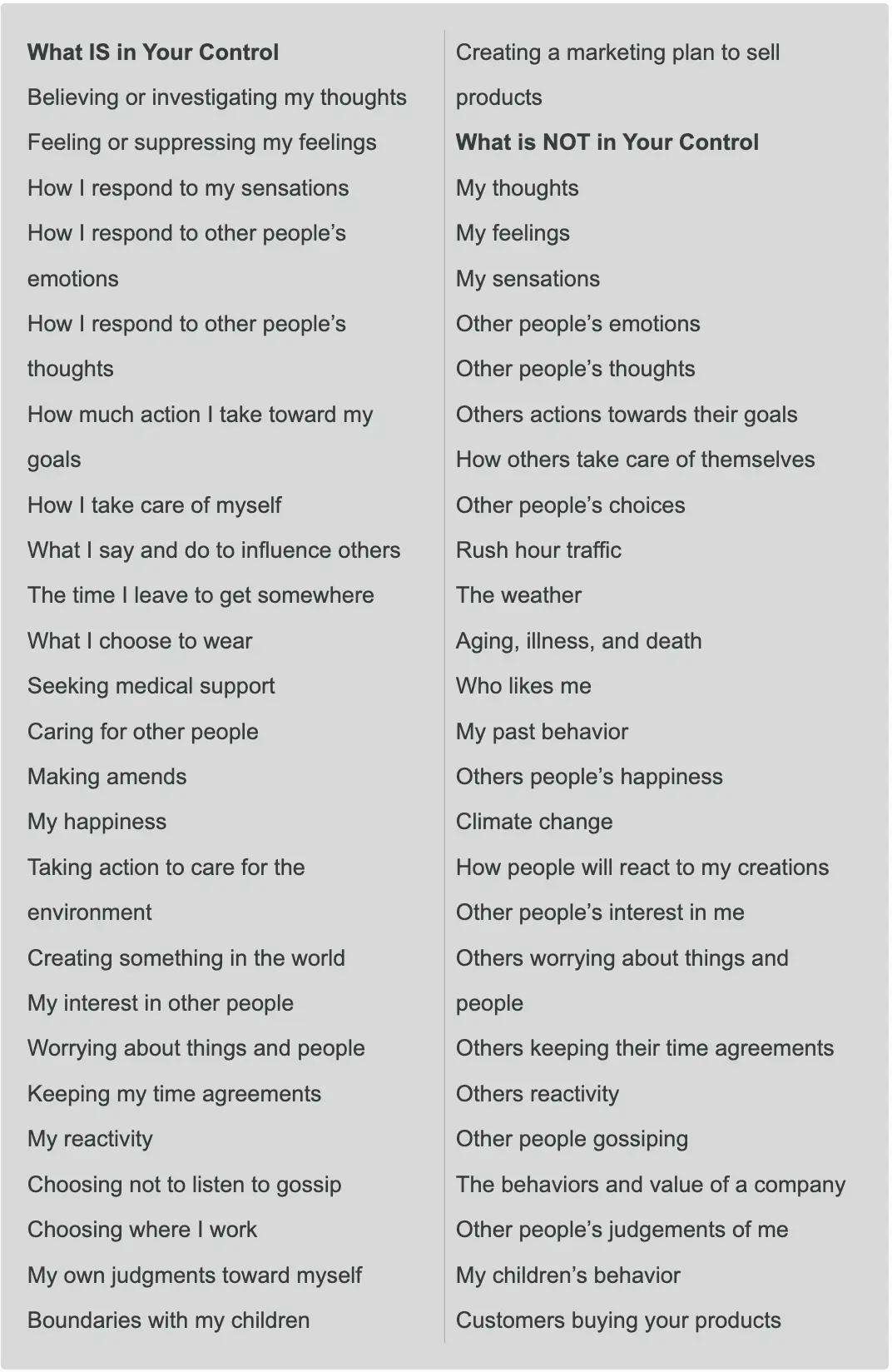
What about this issue can you control and what can you not control? List both. Use this table below as a guide to sort your own list.
What’s In Your Control?
These cultures are best in class in my book. They take root in organizations that value speaking and listening in a way that encourages vibrant and meaningful dialogue. Competitive debate characterizes these cultures.
What I discovered and continue to discover is that there is a conversation beyond even competitive debate. I call it conscious communication. Here are the characteristics of conscious communication:
Take Action
If you’re fixated on something that isn’t under your control, shift your attention from whatever you’re focusing on to something that is under your control.
If you find yourself awake at 3am worrying about your 10am pitch and how it will go (something that is in the future and not under your control), bring your attention back to the present and what is under your control. For example, you could choose to spend a few minutes meditating (under your control) and if your mind quiets (not under your control) you could choose to picture yourself (under your control) easefully giving the pitch. You can’t control what’s going to happen in the future—and worrying isn’t going to help—but you can take responsibility for your state of mind right now, and then direct your attention from presence towards the outcome you’d like to create.
If you’re stressed out because you heard that your child might not get into the school you desperately wanted them to attend notice that your attention is on something out of your control. Bring your attention back to something under your control and see what happens. In this case bring your attention to three things you genuinely and deeply appreciate about your child in this present moment. Choosing to appreciate something is always under our control. (So much of our parental anxiety has nothing to do with who are kids are being right now and is more about who we want them to become in the future or who we’re afraid they will or won’t become). After the shift of attention check out your stress level. From this place of presence and control you’re much more available to your child and yourself.
If you find yourself worrying about something that IS under your control, stop worrying and act.

More
- What’s In Your Control? – Download the process as a PDF Handout to use with your team to differentiate between what you can and cannot control the next time a stressful situation comes up.